
Reviewed · HUE TOURS
Hue Royal Tombs Tour: Visit Best Pagodas & Mausoleums
The emperors left behind extraordinary places. This Hue tour links royal tombs and pagodas by private car, so you can see far more than you could on foot. I like the freedom to shape the route, and I like the local stories about kings, wives, concubines, and eunuchs. The main drawback is that entrance tickets cost extra, and a full eight-hour route can feel demanding in Hue’s heat.
You can book a short visit to a few major sites or spend most of a day moving among five mausoleums and two pagodas. Guides such as Bi, Duy, Ba, and Tra My have earned praise for being friendly, punctual, flexible, and helpful with practical advice, from money exchange to local coffee.
In This Review
- Key points to know before you book
- Why Hue’s royal tombs deserve a full day
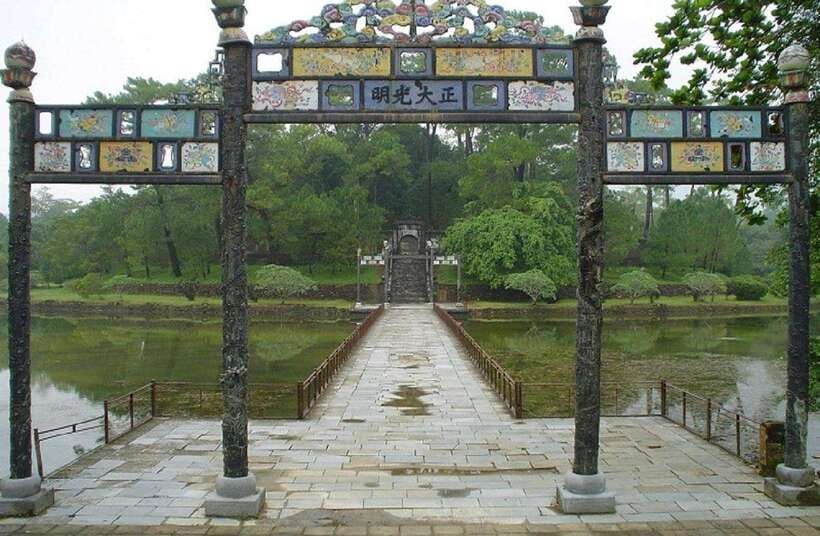
- Tu Duc Tomb, an emperor’s retreat and memorial
- Minh Mang Tomb, formal design and imperial order
- Khai Dinh Tomb, a smaller site with striking mixed styles
- Gia Long Tomb, the dynasty founder’s quieter memorial
- Dong Khanh Tomb, a compact complex with two distinct areas
- Thien Mu Pagoda, Hue’s best-known Buddhist landmark
- Tu Hieu Pagoda, a quieter religious stop
- What the private guide and car add
- Building the right route for your time
- Price, tickets, and the real value
- Who should book this Hue tombs tour?
- Should you book it?
- FAQ
- How much does the Hue Royal Tombs Tour cost?
- How long does the tour last?
- Are entrance tickets included?
- Can I choose which tombs to visit?
- Where does pickup take place?
- Is a tour guide included?
- Can I cancel the booking?
Key points to know before you book
- Private car access matters: Hue’s royal tombs are spread outside the city center, so a private vehicle saves time and energy.
- The route can be personal: Choose from five royal mausoleums and two important pagodas, depending on your interests and available time.
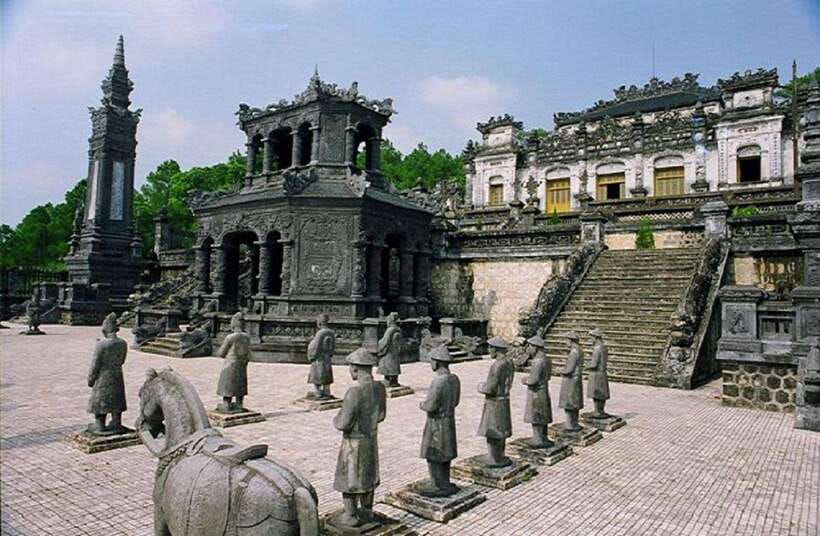
- Each tomb has a different character: Minh Mang feels ordered and formal, Tu Duc feels personal, and Khai Dinh is ornate and unusual.
- Local guides add useful context: Guides explain royal family life, court customs, Buddhism, and the sites passed on the road.
- Tickets are extra: Budget 150,000 Vietnamese dong per tomb, or consider the available combination tickets if you also plan to visit the Imperial City.
- The tour suits small private groups: Pickup and drop-off are available at city-center hotels or Hue Train Station.
Why Hue’s royal tombs deserve a full day

Hue was the political center of Vietnam under the Nguyen Dynasty, and its royal tombs show how each emperor wanted to be remembered. These are not identical monuments lined up for quick photographs. Each complex reflects a ruler’s taste, beliefs, ambitions, and relationship with court life.
I find the tombs most rewarding when you look beyond the main gate. You see temple halls, courtyards, lakes, pavilions, burial grounds, and spaces once used by members of the royal household. The setting is part of the design. The emperors chose sites outside the city, surrounded by wooded hills and quiet rural areas.
The tombs are also scattered. That is why this tour’s private car is more than a comfort. It is the practical backbone of the day. You avoid arranging several rides, and you can spend your energy walking through the monuments instead of negotiating transport between them.
A short two-hour option may suit you if you want one or two major tombs. The longest option can run up to eight hours and allows time for several mausoleums and both pagodas. Read the selected option carefully before paying, since the number of included tombs can vary.
A few more Hue Vietnam runs to compare on price
- Hue Customizable Tour with Imperial Citadel & Forbidden City
★ 4.9 · 937 reviews - Hue :Exploring Royal City with Multi Options and Dragon Boat
★ 5.0 · 675 reviews - Hue City Tour Full Day – Group Tour
★ 4.7 · 518 reviews
Tu Duc Tomb, an emperor’s retreat and memorial
Tu Duc Tomb is a strong first stop because it gives you a personal look at imperial life. Emperor Tu Duc had the complex built from 1864 to 1867, while he was still alive. It served not only as his future burial place, but also as somewhere he could live and work.
The site is divided into two main areas: a temple section and a burial section. That division helps you understand the difference between royal remembrance and daily court life. One area honors the emperor and his family. The other relates to the final resting place.
The complex also became a place for minor wives, concubines, and eunuchs after Tu Duc died in 1883. That detail gives the site a human edge. Royal life was not simply a story of palaces and ceremonies. It involved a large household with strict roles and very different levels of status.
You should allow about 45 minutes here on the standard route. That is enough for a guided walk, photographs, and some free time, though you may want longer if you enjoy architecture or want to move at an unhurried pace.
Minh Mang Tomb, formal design and imperial order
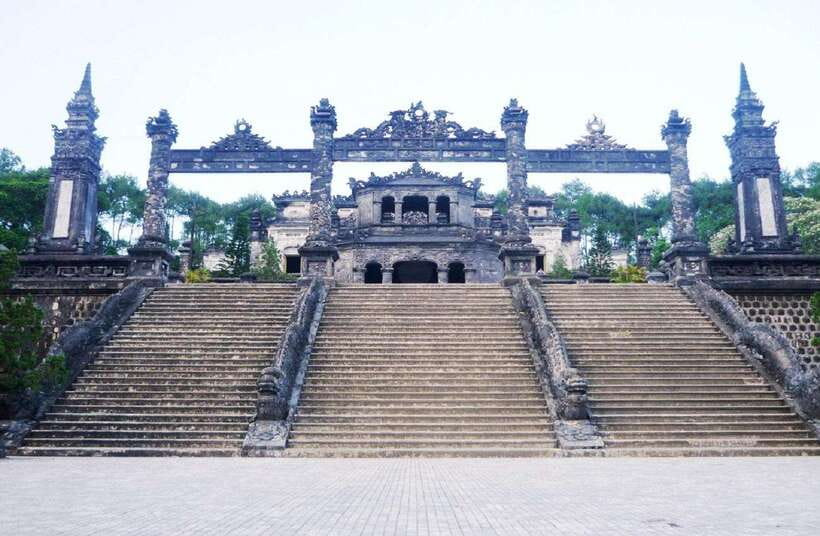
Minh Mang Tomb covers about 15 hectares and contains 26 buildings serving different purposes. Construction began in 1840, after Minh Mang selected the site for himself, but he died before the work was complete. His son, Emperor Thieu Tri, finished it between 1840 and 1843.
The design feels planned and ceremonial. Long approaches, courtyards, halls, and water features create a carefully ordered sequence. I would pay attention to how the buildings relate to one another rather than rushing straight to the central tomb.
Minh Mang’s complex also housed minor wives and concubines who had not borne him children, along with eunuchs, after his death. Your guide can help explain this part of court life, which is easy to miss if you only take photographs and read short signs.
The usual visit lasts around 45 minutes. This is one of the best stops for someone who wants to understand the ideals of Nguyen royal architecture. You get a sense of ceremony, hierarchy, and control.
Khai Dinh Tomb, a smaller site with striking mixed styles
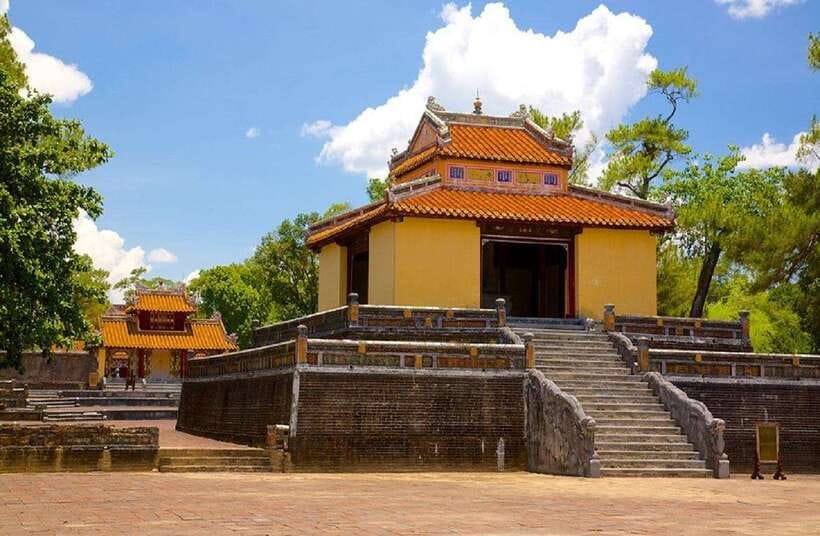
Khai Dinh Tomb looks very different from the larger, more traditional complexes. Work began in 1920 and continued until 1931. Khai Dinh began the project himself, but after his death in 1925, his child completed it.
The tomb combines Asian and European influences. It is the only Nguyen royal tomb in this group described as using such a blended style. Its footprint is about 48.5 meters by 117 meters, making it more compact than Minh Mang or Tu Duc.
The design is dense and decorative rather than open and spacious. You may find the many architectural details more visually intense than the calmer layouts at other tombs. It is also the one tomb in this group where the burial location beneath the monument is known.
The planned stop is about 30 minutes. That can work well if you want to see the key features without making the day too long. If ornate decoration interests you, ask for enough time to look closely rather than treating it as a quick photo stop.
Same city, a very different kind of morning:
- From Hue: DMZ Tour with Vinh Moc Tunnels and Khe Sanh Base
★ 4.9 · 503 reviews - Hue: Private Car to Hoi An via Fabulous Stops
★ 5.0 · 371 reviews - From Hue: Hoi An Bus Transfer with 4 Sightseeing Stops
★ 4.6 · 366 reviews - Hue Imperial Ancient City Walking Tour
★ 4.8 · 308 reviews
Gia Long Tomb, the dynasty founder’s quieter memorial

Gia Long Tomb honors Emperor Gia Long, the founder of the Nguyen Dynasty. Construction began in 1814 and ended in 1820, the year of his death.
The mausoleum is actually a wider complex of royal tombs. It is now in Long Ho Ward, within Hue City. Compared with the more familiar central sites, Gia Long’s complex may feel like a more extended visit because you are seeing a group of related royal memorials rather than one tightly packed monument.
The standard stop lasts about an hour. That longer allocation makes sense. You have more time to walk, take in the setting, and listen to the guide’s explanation of Gia Long’s place in the dynasty.
This stop is best for you if you want more than the three most famous tombs. It can also make the route feel less repetitive, since the day is not limited to the most visited imperial sites.
Dong Khanh Tomb, a compact complex with two distinct areas
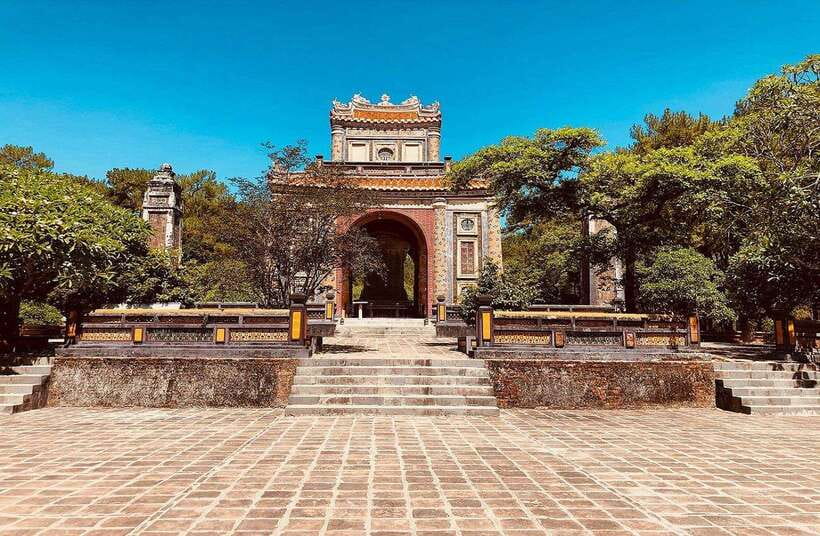
Dong Khanh Tomb, also called Tu Lang, sits in a rural part of Thuong Hai village, in Thuy Xuan Ward. It is part of the Hue ancient capital relic complex and contains around 20 large and small structures.
The tomb is divided into a palace area and a burial area. That layout gives you another chance to compare the practical and ceremonial sides of royal memorials.
The buildings are relatively close together, creating a more compact feeling than the broad grounds at Minh Mang. Your visit here is scheduled for about 30 minutes, which makes it a useful addition when you want to see several styles in one day.
I would not choose Dong Khanh as the only tomb on a short visit. It works better as part of a broader route, especially if you have already seen the major monuments and want a fuller picture of Nguyen Dynasty memorial architecture.
Thien Mu Pagoda, Hue’s best-known Buddhist landmark

Thien Mu Pagoda was built in 1601 by the founder of the Nguyen family in central Vietnam. It is one of Hue’s most important religious sites and was established after a local dream connected the place with spiritual significance.
The pagoda helps balance the imperial focus of the tombs. Here, you shift from royal burial customs to the role of Buddhism in everyday local life. A guide can explain why the site matters and how religious places fit into Hue’s identity.
The stop lasts about 30 minutes and includes time for walking, photographs, and sightseeing. It is a straightforward visit, but do not treat it as filler between tombs. The contrast is valuable. The tombs show how rulers planned their memory. Thien Mu shows a wider religious tradition that continues to matter in Hue.
Tu Hieu Pagoda, a quieter religious stop
Tu Hieu Pagoda is also known as the Root Temple. It is described as one of Hue’s major temples and an important cultural and historical place.
The pagoda is connected with Zen Master Thich Nhat Hanh, the Vietnamese spiritual teacher, poet, and peace activist who became known worldwide for his teachings on mindfulness, ethics, and peace. He lived at Tu Hieu after returning to Vietnam from the United States.
A visit here gives the day a more reflective finish. The standard stop is about 30 minutes, with walking and guided sightseeing. You can ask your guide about the pagoda’s religious role and its connection with Thich Nhat Hanh.
The site may appeal most to you if you want to understand Hue beyond royal monuments. It adds a living spiritual dimension to the route.
What the private guide and car add
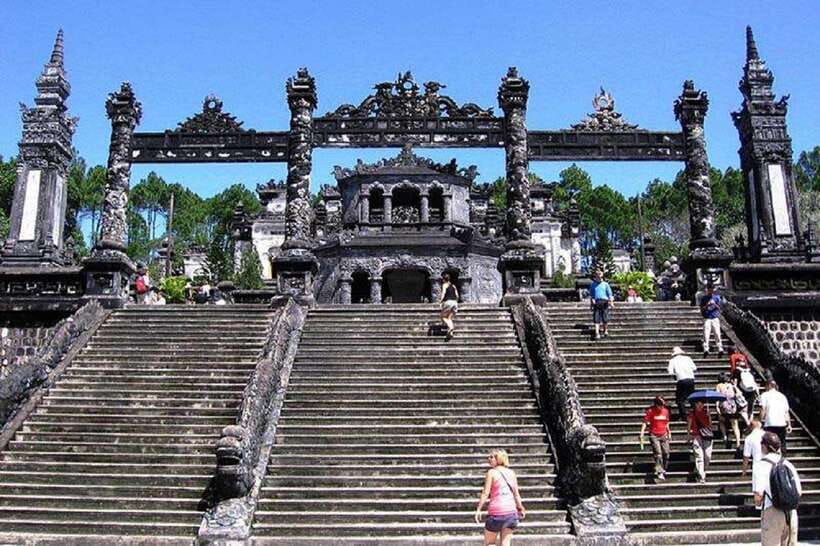
The tour includes private transport by car or van, with pickup in Hue’s city center or at Hue Train Station. City-center hotel pickup and drop-off are included, but you should provide the exact hotel name and address when booking.
The value is simple: the tombs lie far enough apart that arranging each ride separately would waste time. A private vehicle also lets you adjust the pace. You can spend longer at a favorite site or reduce time at one that interests you less.
The guide option is especially useful if you want context rather than just transport. Duy arrived on time, shared information about ancient places along the road, and allowed plenty of time at each stop. Bi was praised for being accommodating and for explaining curiosities during the drives. Ba gave practical advice about sights, transfers, fair prices, money exchange, and even a local salted coffee stop.
Those details matter because the road time is part of the tour. You are not simply being driven in silence between monuments. The right guide turns those transfers into useful orientation.
Still, guide quality can vary by individual. The named guides have received strong praise, but the general booking information only guarantees an English-speaking guide for the guide option. If detailed interpretation matters to you, confirm that you are booking the option with a guide, not only a driver.
Building the right route for your time
For a short visit, I would choose Tu Duc, Minh Mang, and Khai Dinh. Together they show three contrasting approaches: a personal retreat, a formal imperial complex, and a highly decorated monument with European influence.
If you have more time, add Thien Mu Pagoda. It gives the day a needed change of pace and shows why Buddhism matters in Hue.
For a longer day, include Gia Long and Dong Khanh, then add Tu Hieu Pagoda if religious history interests you. Five tombs plus two pagodas can be a lot. The stated maximum duration is eight hours, and you should expect considerable walking at several sites.
You can also use the car to protect your energy. Hue can be hot, and the combination of outdoor courtyards, steps, and walking paths adds up. The private format is more comfortable than trying to force every stop into a fixed group schedule.
Price, tickets, and the real value
The advertised starting price is $15 per person, which is low for private transport and a customizable route. But treat it as a starting price, not the full cost of a day visiting every site.
Entrance tickets are not included. The stated fee is 150,000 Vietnamese dong per tomb per person. If you also plan to visit the Imperial City, combination tickets may offer better value: 420,000 dong per person for the Imperial City plus two tombs, or 530,000 dong for the Imperial City plus three tombs. These tickets are valid for two days.
The math favors planning ahead. If you want only one or two tombs, paying individual admission may be simpler. If you want three tombs and the Imperial City, the combination ticket can reduce the total cost and make your sightseeing plan easier.
Food and drinks are also not included. Bring your own budget for refreshments, and ask your guide if you want a local stop. Ba’s suggestion of salted coffee shows the kind of practical local help that can make the day more personal, but it is not a guaranteed part of every booking.
Who should book this Hue tombs tour?
I would recommend it to first-time visitors who want to see the major royal sites without arranging several rides. It is also a good fit for couples, families, and private groups who prefer control over the pace.
You will get the most from it if you enjoy history, architecture, royal customs, and religious culture. The explanations about wives, concubines, eunuchs, and imperial family life add meaning to buildings that might otherwise blur together.
It is less suitable if you want a fixed, tightly scripted tour with every detail locked in. The route is flexible, and the exact number of tombs depends on the option you select. It may also be too much if you dislike walking or prefer a very slow day at one monument.
The tour is listed as wheelchair accessible, which is useful, but the supplied information does not describe access conditions at each individual tomb. If you need specific assistance, ask before booking.
Should you book it?
Book this tour if you want private transport, flexible sightseeing, and local explanation at a modest starting price. The strongest practical benefits are the door-to-door pickup, the ability to choose your tombs, and guides who have been praised for punctuality, kindness, and useful local advice.
Choose a shorter option for Tu Duc, Minh Mang, and Khai Dinh if this is your first visit. Choose the longer route only if you genuinely want five tombs and two pagodas. Add the Imperial City ticket to your budget, compare the combination prices, and confirm exactly which sites your selected option includes.
With a 4.9 rating from 19 verified bookings, the service has a strong record so far. I would book it for an efficient first look at Hue, especially with a guide included. If you prefer to explore every site slowly and independently, hire a car and plan fewer stops instead.
FAQ
How much does the Hue Royal Tombs Tour cost?
The starting price is $15 per person. The final price can vary by option, especially because different options include different numbers of royal tombs.
How long does the tour last?
The available duration ranges from 2 to 8 hours. The exact length depends on the route and the number of tombs and pagodas selected.
Are entrance tickets included?
No. Tomb entrance tickets cost 150,000 Vietnamese dong per tomb per person. Combination tickets are available for the Imperial City and two or three tombs.
Can I choose which tombs to visit?
Yes. The route can be customized. Available sites include the tombs of Tu Duc, Minh Mang, Khai Dinh, Gia Long, and Dong Khanh, along with Thien Mu and Tu Hieu pagodas.
Where does pickup take place?
Pickup and drop-off are available at hotels in Hue city center or at Hue Train Station. You should provide the exact hotel name and address when booking.
Is a tour guide included?
A live English-speaking guide is included with the guide option. Private transportation by car or van is included.
Can I cancel the booking?
You can cancel up to 24 hours in advance for a full refund. The reserve-now, pay-later option lets you book without paying immediately.
New around Hue Vietnam
- Phong Nha National Park: Paradise Cave Half-Day Tour★ 5.0 · 23 reviews
- Official Hue: Dragon Boat, Imperial Citadel, & Market tour★ 4.7 · 32 reviews
- Hue to Hoi An by bus: Hai Van Pass, Lang Co, Marble mountain★ 4.6 · 27 reviews
- Hue to Hoi An/Da Nang: Private Scenic Motorbike Tour★ 4.9 · 63 reviews
- Hue: Private Transfer to/from Hoi An via Sightseeing Stops★ 4.9 · 111 reviews
- Hue: Royal Tombs Private Tour with 3 Best Tombs & Pagoda★ 4.9 · 213 reviews
- Hue Private Tour with Local Guide – Customize Your Itinerary★ 4.8 · 28 reviews
- Hue : Private Day Trip to DMZ : Vinh Moc tunnel & Khe Sanh★ 5.0 · 26 reviews
Hue Tours, compared.

Hue to Hoi An ( Hoi An to Hue) Top Gear with Lefamily Riders Tours ( 1 way)
Read our review →
Easy Rider private tour via Hai Van pass from Hue – Da Nang – Hoi An (1Way|Loop)
Read our review →
Hue Customizable Tour with Imperial Citadel & Forbidden City
Read our review →
Imperial City, Hue: Day Tour from Hoi An and Da Nang
Read our review →
Easy Rider From Hue Da Nang Hoi An Via Hai Van Pass With Mister T
Read our review →
Hue to Dn/Hoi An: Hai Van Pass, beaches & Mt Monkey or vice versa
Read our review →
Imperial City Walk, Motorbike Tour & Private Car Options
Read our review →
Exploring Royal City with Multi Options and Dragon Boat
Read our review →Browse the lists this tour appears in