
Reviewed · HANOI TOURS
Hanoi Knife-Making Class:Join the Legacy in Blacksmith’s Workshop
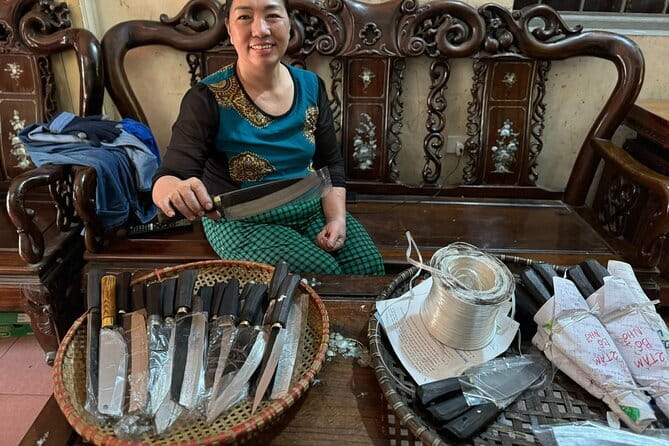
Fire, steel, and a village craft come together here. This Hanoi knife-making class takes you to Da Sy, a centuries-old blacksmithing village where you design, forge, shape, and sharpen a working knife under the care of a master artisan. I especially like the hands-on work and the chance to learn from Tuyen, a female blacksmith who has spent 44 years protecting this trade.
I also like the personal scale. The workshop allows no more than 10 people, and the artisan works beside you rather than simply demonstrating from across the room. The main consideration is that this is physical, hot, and noisy work, not a quiet craft class. You will handle hammers, metal, grinding tools, and fire, though safety equipment and instruction are provided.
In This Review
- What makes this class special
- Da Sy, where knife making is part of daily life
- Meeting Tuyen, the female blacksmith with 44 years at the forge
- Choosing a design before the fire starts
- Forging the blade with traditional tools
- Shaping the rough metal into a real knife
- The grindstone and the tar-based sharpening method
- What the $45.51 price really buys you
- Who will enjoy this and who may not
- Getting your handmade knife home
- Booking, group size, and cancellation details
- Should you book the Da Sy knife-making class?
- FAQ
- Where does the knife-making class take place?
- How long does the experience last?
- How much does the class cost?
- What is included in the price?
- Do I make the entire knife myself?
- Who teaches the class?
- How many people can join the class?
- Can I cancel for a full refund?
- Can I take the finished knife home?
What makes this class special
- Da Sy’s centuries-old forge tradition: Visit a working blacksmith village once known for supplying weaponry during Vietnam’s wars.
- Tuyen’s 44 years of craft: Learn from the only officially recognized female artisan in this trade.
- A knife made by your own hands: Choose a design, forge the blade, shape it, work on the handle, and sharpen the finished piece.
- An unusual sharpening method: See a rare tar-based wash used as part of a family technique passed down through generations.
- A small workshop setting: The class has a maximum of 10 people, keeping the instruction close and practical.
- A useful souvenir: You leave with a functional knife rather than a decorative trinket, but you should check your home-country rules before flying with it.
Da Sy, where knife making is part of daily life
The class begins at Đa Sỹ, Kiến Hưng, in Hanoi’s Hà Đông district. This is not a staged demonstration set up only for tourists. Da Sy is known for blacksmithing, and its reputation reaches back through centuries of blade-making. The village also has a connection to Vietnam’s wartime past, when local smiths supplied weaponry.
That background gives the class more weight than a standard craft workshop. You are not simply making an object in a clean studio. You are working in the setting where this kind of skill has been handed from one generation to the next.
The experience takes place at the artisan’s house. That matters. A home workshop feels more direct and less polished than a purpose-built attraction, but it also gives you a closer look at how the craft is practiced. Expect the sounds and working conditions of a real forge rather than a calm room with tidy display tables.
The class lasts about two and a half hours. That is enough time to move through the major stages without turning the experience into a full-day commitment. You can fit it into a Hanoi sightseeing schedule, though I would avoid placing it immediately before an important dinner reservation. The timing can be active and tiring.
A few more Hanoi runs to compare on price
- Hanoi Cooking Class: Culture, Local Market & Meaning CSR Impact
★ 5.0 · 5,147 reviews - 5 Traditional Dishes Hanoi Cooking Class with Market Trip
★ 5.0 · 4,890 reviews - Hanoi Coffee Workshop: Taste Salt, Coconut and Egg Coffee
★ 5.0 · 1,286 reviews
Meeting Tuyen, the female blacksmith with 44 years at the forge
The most important part of this experience is the person teaching it. Tuyen is described as the only officially recognized female artisan in this trade, with 44 years devoted to the work. Her role adds a human story to the metalwork, especially in a field often associated with male blacksmiths.
Her job is not just to show you a finished knife. She guides each stage, helps you use the tools, and corrects the work as you go. That makes the class suitable for beginners who have never held a forging hammer before.
A guide or interpreter joins the class to help explain the process. Names associated with past sessions include Mint, Nick, and Tulip. Mint has been praised for being personable and charming, while Nick has also helped with Hanoi food suggestions. The exact guide may vary, but the setup is clear: you receive help with both the craft and the explanations.
That language support is useful because blacksmithing involves more than a few simple instructions. You need to understand how to hold a tool, where to strike, when to stop, and how each step affects the next. A good interpreter helps turn a potentially confusing process into something you can follow.
Choosing a design before the fire starts
Your work begins with design. You sketch the blade shape onto a selected piece of durable metal, chosen for strength and quality. This is a small but important choice because it gives your knife a personal character before any hammering begins.
You will need to think about the blade’s outline and proportions. The class information does not promise a set menu of blade styles, so the final design may depend on the available metal and the artisan’s advice. That is a good reason to listen closely before you commit to a shape.
The tang, or the part of the blade that enters the handle, is also cut as part of the early work. This is a useful detail for anyone interested in how a knife is actually constructed. You are not simply decorating a premade blade. You are working with the basic pieces that make the tool functional.
The design stage also sets the pace for the rest of the session. If you want a bold or unusual form, ask what is practical before cutting the metal. The aim is to make something you can use, not only something that looks interesting in a photograph.
Forging the blade with traditional tools
After the design is marked, you cut out the blade and tang using traditional tools such as hammers, cutters, and an anvil. The metal is then heated in the forge so it can be shaped.
This is the part many people picture when they hear the word blacksmithing, and it is as physical as it sounds. You take turns hammering the heated metal while the artisan helps you keep the form under control. The metal must be shaped with care, and the artisan’s experience becomes obvious here.
The class is described as fully hands-on, but that does not mean you are left to manage dangerous work alone. Tuyen works beside you and guides the process. Safety equipment is provided, and the workshop supplies all tools needed for the knife-making session.
Still, you should arrive ready for heat, effort, and noise. This is not a relaxed painting class where you can work at your own pace in silence. If you dislike hot workshops or physical tools, this may not be your best Hanoi activity. If you enjoy making things and do not mind getting involved, the work is the point.
Same city, a very different kind of morning:
- Hanoi Jeep Tour: Food, Culture and Fun by Vietnam Army Jeep
★ 5.0 · 15,222 reviews - Full-Day Ninh Binh Highlights Tour from Hanoi
★ 5.0 · 7,761 reviews - Hanoi: Ha Long Bay Day Cruise – Swimming, Meal, Kayaking
★ 4.7 · 7,415 reviews - Hanoi: Water Puppet Show Tickets
★ 4.6 · 7,029 reviews
Shaping the rough metal into a real knife
Once the metal has been forged, the blade needs more controlled shaping. You continue refining the form with the artisan’s help, taking away rough edges and correcting the outline.
A hydraulic machine is used to help smooth and refine the metal. This combination of old and newer equipment is one of the practical strengths of the workshop. Traditional hammering creates the shape, while the machine helps with the less forgiving finishing work.
The process gives you a better sense of how much labor sits behind an ordinary kitchen knife. A finished blade can look simple, but the shape depends on repeated heating, striking, trimming, and smoothing. By making one yourself, you see why handmade tools carry a different value from factory-made souvenirs.
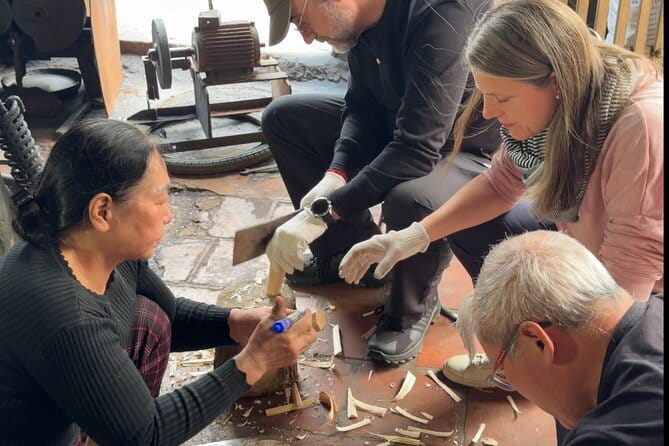
Some sessions also include work on the handle, beginning with a block of wood with bark. You may carve and shape it to suit your knife. This detail makes the finished piece feel more personal because the handle is not treated as an afterthought.
The exact amount of handle customization may vary, so ask the artisan what is possible for your chosen design. The available time is about two and a half hours, which means the class must keep moving through each stage.
The grindstone and the tar-based sharpening method
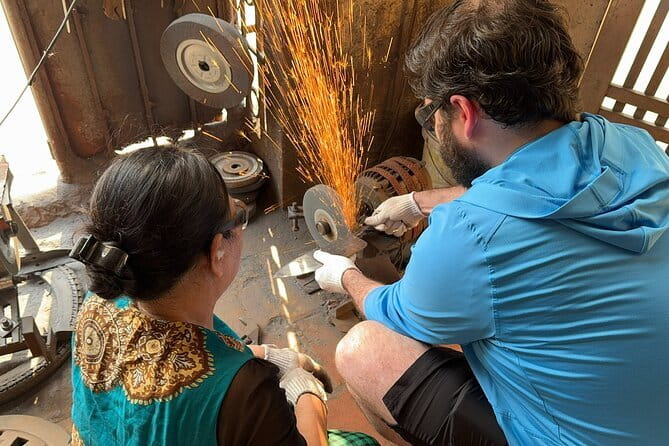
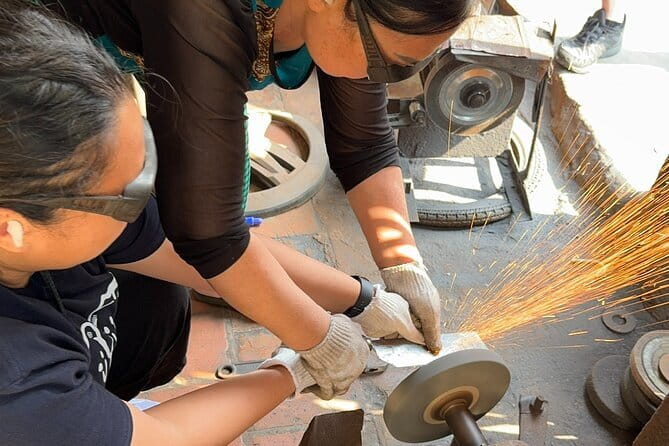
Sharpening is the final major step. You work the blade against a grindstone, following several stages to create a usable edge. This is where patience matters most. A knife that looks finished can still need careful attention before it cuts properly.
The class includes a rare tar-based wash connected to the artisan family’s sharpening tradition. It is an unusual detail and one of the most memorable parts of the session. Rather than treating sharpening as a simple final polish, the workshop shows you a technique passed down through generations.
You should pay close attention here. Sharpening is both a craft and a safety issue. The artisan helps ensure that your blade reaches a practical finish, while you learn how much control is needed to keep the edge even.
The final result is not a factory-perfect object. That is part of its appeal. Your knife will carry the marks of your choices and your level of skill. It may not look identical to one made by a professional, but it will be yours in a way a purchased souvenir cannot be.
What the $45.51 price really buys you
At $45.51 per person, this is not the cheapest activity in Hanoi. The price becomes easier to justify when you consider what is included: instruction, workshop access, metal, tools, safety equipment, and a handmade knife to take home.
You are also paying for time with a highly experienced artisan. The class is not just a short forge visit followed by a souvenir purchase. You take part in design, cutting, forging, shaping, handle work, grinding, and sharpening.
Value depends on what you want from a cultural activity. If you want a quick photo opportunity, this class may feel too involved. If you want a practical skill, a personal object, and direct contact with a Vietnamese craft tradition, the cost is reasonable.
A useful tip from the class format is that one ticket may be enough if only one person in your group wants to make a knife. One participant has booked a single ticket specifically to create one shared knife. Confirm the provider’s current ticket rules before booking, but this can reduce the cost for a couple or family that wants one finished piece rather than one knife per person.
Tips are optional and not included. The class ends back at the starting point in Đa Sỹ. Private bookings with a car have also been arranged, but transport details should be confirmed directly if you need a pickup rather than making your own way to the meeting point.
Who will enjoy this and who may not
I would choose this class if you like working with your hands, prefer local craft to polished attractions, or want a souvenir with a story attached. It also suits people who have already seen Hanoi’s main sights and want an activity that feels different from food tours, museums, and standard handicraft sessions.
It is a strong choice for couples or small groups because you can compare designs and share the work. It can also suit solo participants, especially with a maximum group size of 10 and close guidance from the artisan.
Families should consider the age and comfort of each participant. The available information says most people can take part, but it does not give a minimum age. The work involves hot metal, sharp tools, hammers, and grinding equipment, so ask the provider before booking for a child.
This is not the right pick if you want a quiet or passive activity. It is also not ideal for anyone who needs a fully relaxed schedule. The class is active and can be demanding, even though the artisans support beginners.
Getting your handmade knife home
A handmade knife makes an excellent souvenir, but it also creates a practical problem. You should check the rules for your airline and home country before booking, especially if you choose a longer blade or an unusual shape.
One participant specifically noted checking airport regulations for a 14-centimeter knife. That is a useful warning, not a reason to skip the class. Ask about safe packing and transport, and do not assume that a knife allowed in checked luggage will be allowed in carry-on baggage.
The provider has helped arrange sending knives home in at least some cases, but you should confirm the current option before relying on it. If you are flying soon after the class, build in time to solve the transport question.
Booking, group size, and cancellation details
The experience accepts mobile tickets, and confirmation is provided when you book. Service animals are allowed, and the meeting point is near public transportation.
The maximum group size is 10. That is small enough to keep the class personal, though the amount of one-on-one time can still depend on how many people attend and which stage they are working on.
Free cancellation is available if you cancel at least 24 hours before the local start time. Cancellations within 24 hours are not refunded, and changes inside that window are not accepted. Keep that deadline in mind when planning around Hanoi traffic or a changing flight schedule.
Should you book the Da Sy knife-making class?
I would book it if you want an authentic, hands-on Hanoi experience and you are comfortable with heat, noise, and physical work. The combination of Da Sy’s old blacksmithing tradition, Tuyen’s 44 years at the forge, patient guidance, and a knife you help make gives the class real substance.
I would skip it if your ideal afternoon involves sitting quietly, avoiding sharp tools, or carrying no extra baggage home. For everyone else, $45.51 buys more than a souvenir. You get a short lesson in Vietnamese craft, direct time with an artisan, and a useful object that still carries the marks of your own effort.
FAQ
Where does the knife-making class take place?
The class starts at Đa Sỹ, Kiến Hưng, Hà Đông, Hà Nội, Vietnam. It takes place at the artisan’s house and ends back at the meeting point.
How long does the experience last?
The class lasts approximately 2 hours and 30 minutes.
How much does the class cost?
The listed price is $45.51 per person.
What is included in the price?
All tools and necessary safety equipment for knife making are provided at the artisan’s house.
Do I make the entire knife myself?
You take part in the main stages, including design, cutting the blade and tang, forging, shaping, handle work, grinding, and sharpening. The artisan guides and assists you throughout the process.
Who teaches the class?
The class is led by skilled artisans, including Tuyen, an officially recognized female artisan who has dedicated 44 years to the craft. An interpreter or guide also helps explain the process.
How many people can join the class?
The maximum group size is 10 people.
Can I cancel for a full refund?
Yes. You can receive a full refund if you cancel at least 24 hours before the experience’s local start time. Cancellations or changes made within 24 hours are not accepted for a refund.
Can I take the finished knife home?
The experience is designed for you to take home your handmade knife. You should check your airline and home-country regulations before traveling with it, especially regarding baggage and blade length.
New around Hanoi
- Private LUXURY Hanoi City Full day guided tour★ 4.5 · 21 reviews
- Private transfer between Hanoi and Sapa★ 5.0 · 27 reviews
- Private Transfer Hanoi <=> Mai Chau One Way (Free hotel pickup)★ 5.0 · 22 reviews
- Private Transfer from Ninh Binh to Halong or Halong to Ninh Binh★ 5.0 · 21 reviews
- Private Transfers Hanoi <=> Halong One Way (Free Hotel Pickup)★ 5.0 · 31 reviews
- Hanoi Airport See-off (Private Ride from Hotels to Hanoi Airport)★ 4.5 · 70 reviews
- Thang Long Water Puppet Theater★ 4.5 · 45 reviews
- Private transfer Ninh Binh <=> Halong One Way (Free Hotel Pickup)★ 5.0 · 21 reviews
Hanoi Tours, compared.

Hanoi Jeep Tour: Food, Culture and Fun by Vietnam Army Jeep
Read our review →
Full-Day Ninh Binh Highlights Tour from Hanoi
Read our review →
Ha Long Bay Day Cruise – Swimming, Meal, Kayaking
Read our review →

Hanoi Motorbike Tour: Food, Culture and Fun by Vintage Motorbike
Read our review →

Hanoi Cooking Class: Culture, Local Market & Meaning CSR Impact
Read our review →
5 Traditional Dishes Hanoi Cooking Class with Market Trip
Read our review →Browse the lists this tour appears in