
Reviewed · HANOI TOURS
Hanoi Knife Making Traditional Workshop
Fire, steel, and a family craft. This Hanoi workshop takes you beyond the city center to a traditional forging village, where you make a simple knife from raw metal. I like the hands-on work, and I like that you meet the family members who still practice a trade passed through generations. The main thing to consider is that this is physical work in a real forge, not a polished demonstration.
The experience lasts about three and a half hours and costs $50 per person. That price includes an air-conditioned vehicle, iron material, and an English-speaking guide. Nathan, one of the guides, has earned praise for being patient and engaging, but the workshop itself is led by experienced local bladesmiths. You should have a moderate level of fitness and be comfortable with heat, hammering, grinding, and a few rough edges.
In This Review
- Key points before you book
- Why this Hanoi craft workshop is worth your time
- Reaching the forging village from Hanoi
- Sketching the blade before the fire
- Cutting the blade and tang at the anvil
- Shaping the metal with the family maker
- Sharpening the blade and the tar-based wash
- Meeting local makers instead of watching a staged show
- What the $50 price includes
- Who will enjoy this class most
- Timing, weather, and cancellation details
- Should you book the Hanoi knife-making workshop?
- FAQ
- How long does the knife-making workshop last?
- How much does the experience cost?
- Is transportation included?
- Is an English-speaking guide included?
- What will I do during the class?
- Is lunch included?
- What is the cancellation policy?
Key points before you book
- You make a real knife from iron: The process covers design, cutting, forging, shaping, and sharpening rather than stopping at a simple demonstration.
- The workshop is in a traditional forging village: The community has worked with metal for several hundred years and once supplied weapons during Vietnam’s wars.
- You work beside family bladesmiths: Local makers guide you through the process, with family members continuing a trade that some begin learning at about age 12.
- The final sharpening includes a family recipe: Your blade is treated in a tar-based chemical wash used as part of the sharpening process.
- Small groups keep the lesson practical: The maximum group size is 10, so you should have more direct contact with the makers than on a large factory visit.
- Pickup and group discounts are available: An air-conditioned vehicle is included, and the experience offers pickup, mobile tickets, and discounts for groups.
Why this Hanoi craft workshop is worth your time
Hanoi offers plenty of food tours, temple visits, and city walks. Those are good choices, but a knife-making class gives you a different view of Vietnam. You are not simply looking at an old craft from behind a barrier. You take part in the work and leave with a useful object made through a traditional process.
I especially like the link between the village’s past and its present. The area once produced weapons during wartime. Today, the same forging skills are used for agricultural tools and household blades. That change tells you something important about local craft: it survives by staying useful.
The class also gives you a chance to speak with local people in a natural setting. The family members working in the forge are not there only to perform a short show. They guide you through a process they have practiced for years. One maker explained that people in the family can start learning the trade around age 12, which helps explain the speed and control you see at the anvil.
This is not a souvenir workshop where you decorate a pre-made item. Your knife begins as a piece of metal. You choose or sketch its basic shape, help cut it, heat it, hammer it, and take part in sharpening. The result will be simple, but it carries a story that a shop-bought souvenir cannot.
A few more Hanoi runs to compare on price
- Hanoi Cooking Class: Culture, Local Market & Meaning CSR Impact
★ 5.0 · 5,147 reviews - 5 Traditional Dishes Hanoi Cooking Class with Market Trip
★ 5.0 · 4,890 reviews - Hanoi Coffee Workshop: Taste Salt, Coconut and Egg Coffee
★ 5.0 · 1,286 reviews
Reaching the forging village from Hanoi
The experience begins in Hanoi, with pickup offered and transport provided in an air-conditioned vehicle. The exact pickup point and departure details should be confirmed when you book, since the supplied information does not specify individual hotel coverage or a precise meeting place.
The drive takes you away from the central city toward a traditional craft village on Hanoi’s outskirts. That change of setting is part of the appeal. You move from Hanoi’s streets and modern buildings into a community shaped by workshops, family skills, and metalwork.
The total experience lasts about three hours and 30 minutes. That is long enough to cover the full process without turning the class into an all-day commitment. You should still allow extra time around the scheduled activity for pickup and the journey, since the stated duration refers to the experience itself.
The group limit is 10 people. That is a useful number for this kind of class. With too many people, hammering and shaping become something you watch from the side. A group of 10 or fewer gives the guide and makers a better chance to help each person.
Sketching the blade before the fire
Your first task is to sketch the blade shape on a sheet of metal selected for durability. This is a small step, but it gives you a clear sense of ownership. You are not only handed a finished blade and asked to polish it. The shape begins with your decisions.
The sketch also introduces you to the basic parts of a knife. The blade is the cutting section, while the tang is the part that extends into the handle. At this stage, you start to see how the shape of the metal needs to work as a whole.
Do not expect a technical design class with a long discussion of steel types or blade geometry. The information provided describes a simple knife-making process, so the emphasis is on doing rather than theory. That suits most people who want a practical cultural activity rather than a formal blacksmithing course.
If you enjoy making things with your hands, this opening stage will likely be one of the most satisfying. It also gives you a chance to choose the size of the blade. A direct account of the experience notes that participants were allowed to select the size of their knife, though the exact options may depend on the workshop and the available material.
Cutting the blade and tang at the anvil
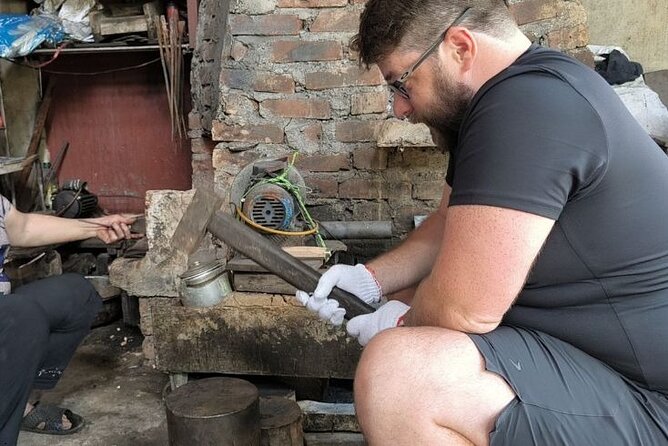
Once the design is marked, you help cut out the blade and tang with a hammer and cutter. The work takes place at the anvil, which is the heart of the traditional forge.
You then place the metal into crackling embers. The heat softens the iron enough for shaping, while the maker controls the process and helps you work at the right moment. You should expect close guidance here. This is not a place to swing a hammer without instruction, and the bladesmith’s experience matters.
The setting is a working forge, so the atmosphere is more practical than theatrical. You may see the tools, fire, and equipment used for regular metalwork. That gives the class its character, but it also means you should be ready for heat, noise, and physical effort.
The workshop’s traditional roots make this part especially meaningful. The village has forged metal for several hundred years, and the same basic relationship between fire, hammer, and anvil still shapes the work today. The tools may include modern equipment where needed, but the central skill remains hand forging.
Same city, a very different kind of morning:
- Hanoi Jeep Tour: Food, Culture and Fun by Vietnam Army Jeep
★ 5.0 · 15,222 reviews - Full-Day Ninh Binh Highlights Tour from Hanoi
★ 5.0 · 7,761 reviews - Hanoi: Ha Long Bay Day Cruise – Swimming, Meal, Kayaking
★ 4.7 · 7,415 reviews - Hanoi: Water Puppet Show Tickets
★ 4.6 · 7,029 reviews
Shaping the metal with the family maker
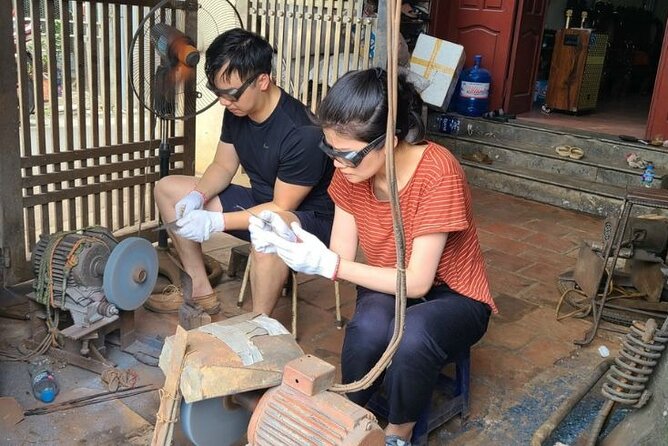
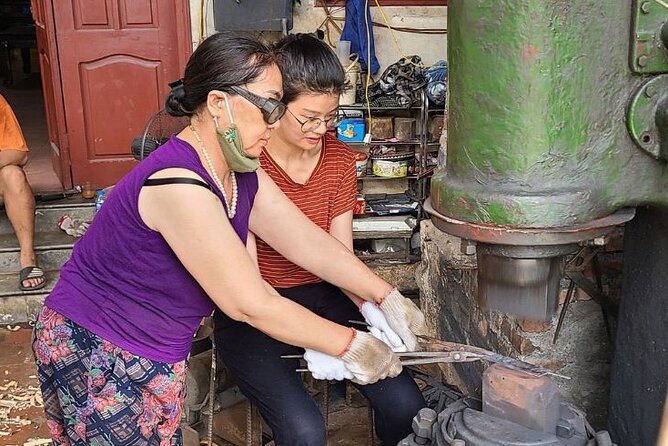
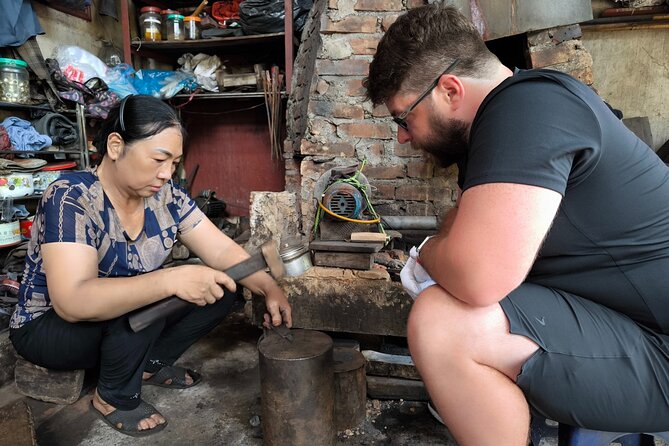
The most memorable part of the class is likely the shaping stage. You alternate hammer blows with the maker, gradually forming the blade into shape.
That shared rhythm matters. You get to feel how much force is needed, while the bladesmith corrects the angle and timing. The finished maker has years of practice, so your role is not to match that speed. Your role is to take part, learn the movement, and help form the metal.
This is also where patience becomes important. A knife does not appear after a few dramatic strikes. The blade needs repeated heating and shaping, and small imperfections may need correction. A hydraulic cutting machine is used to trim flaws and clean up the form when necessary.
The combination of old and new methods is practical. The forge and hammer connect you with the village’s traditional trade, while the hydraulic machine helps produce a cleaner result. You get the experience of handwork without expecting a beginner to perform every technical step alone.
I would not book this class if you want a quiet, effortless activity. You will need to pay attention, follow directions, and use your arms. The physical demand is not described as extreme, but a moderate fitness level is required. Closed, sturdy clothing and shoes are sensible choices, though the supplied details do not specify a formal dress code.
Sharpening the blade and the tar-based wash
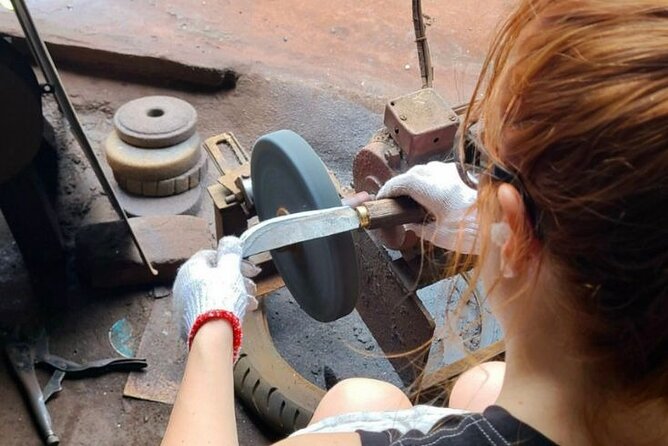
After shaping, the blade moves to the grindstone. Sharpening happens in several stages, so this is more than a quick pass over a stone.
One stage includes soaking the blade in a special tar-based chemical wash. The formula is described as a secret family recipe. That detail gives the final part of the class a strong connection to the family workshop. You are seeing a method that is treated as part of the maker’s own practice, not simply following a generic craft kit.
The grindstone work also shows why a finished knife is the result of several linked skills. Cutting the outline is only the beginning. The maker needs to bring together the correct shape, an even edge, and a usable final form.
You should keep your expectations sensible. The description promises a simple knife, not a professional chef’s blade made to a custom specification. The value is in the process and the connection to the craft. You take home an unusual souvenir, but the lesson is the main event.
Meeting local makers instead of watching a staged show
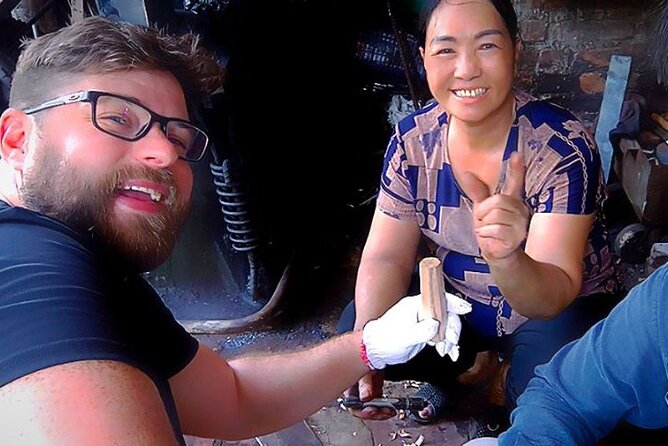
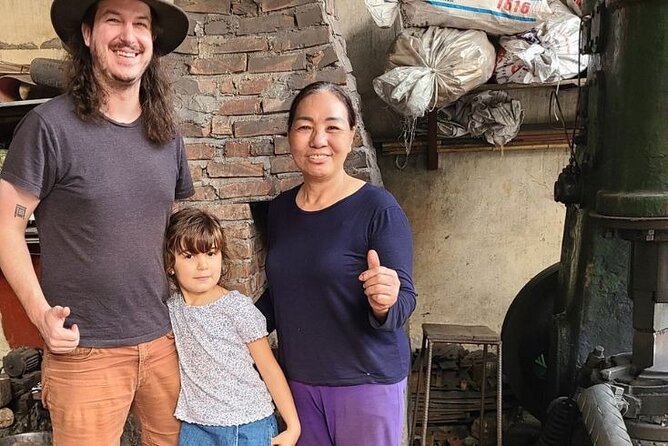
The family setting is one of the strongest reasons to choose this experience. The craft has continued across generations, and the people you meet can explain the work from direct experience.
That contact makes the workshop feel personal. You are not only being told that the village has a long forging tradition. You see how the skill is practiced and how family members contribute to the work. The detail about learning from around age 12 gives you a glimpse into how such a demanding trade is passed along.
An English-speaking guide is included. Nathan is specifically praised for being patient, engaging, and good company during the journey. That is useful because the local makers may not provide all the explanation in English, and a guide can help connect the practical work with the wider story of the village.
You should also remember that this remains a working environment. It may not have the tidy presentation of a museum. That is a benefit if you want something direct and hands-on, but a drawback if you expect a polished visitor center, extensive displays, or a long formal talk about Vietnamese metalwork.
What the $50 price includes
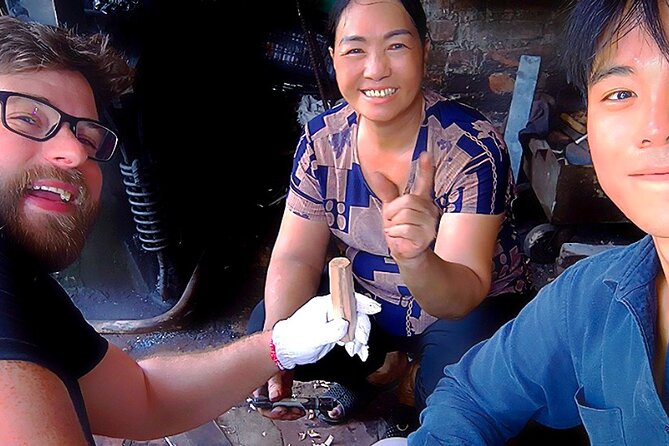
At $50 per person, the price is reasonable for a small-group experience that combines transportation, instruction, material, and a finished knife. You are paying for more than a short craft demonstration. The class covers the full path from raw metal to sharpened blade.
The included air-conditioned vehicle adds value, especially when you are leaving Hanoi for a village outside the center. Iron material is also included, so you do not need to arrange your own metal before arriving. An English-speaking guide helps make the activity easier to follow.
Lunch is not included, and tips are also separate. The supplied details do not say how long the drive takes or where lunch might be available, so plan your food around the activity rather than assuming a meal is provided.
Group discounts may make the experience a better deal for friends or families booking together. The maximum group size is 10, which keeps the session from becoming too crowded. Mobile ticketing is available, so you can keep the booking on your phone.
Who will enjoy this class most
I would recommend this activity to you if you like practical cultural experiences, small workshops, and souvenirs with a story. It suits people who would not normally have a chance to work at a forge at home but want to try something unusual while abroad.
It is also a good fit for couples, friends, and families with older children who can follow instructions and handle a physical activity. The information does not provide a specific minimum age, so you should ask the provider before booking for younger children.
You may also enjoy it if you have an interest in cooking. The finished item is a cooking knife, according to the experience title and description, so the souvenir has a clear use rather than being only decorative.
This is less suitable for anyone who dislikes heat, hammering, grinding, or workshop conditions. It may also disappoint you if you want a long, detailed lesson in advanced knife design. The class focuses on making one simple knife and experiencing the traditional process.
Timing, weather, and cancellation details
Free cancellation is available if you cancel at least 24 hours before the start time. Cancellation within 24 hours is not refunded, and changes made during that period are not accepted.
The activity depends on good weather. If poor weather forces a cancellation, you are offered another date or a full refund. The same choice applies if the minimum number of participants is not reached.
You receive confirmation when booking. Since pickup is offered but exact pickup arrangements are not provided here, check the confirmation carefully for your time and meeting details.
Should you book the Hanoi knife-making workshop?
Book it if you want to do something genuinely different in Hanoi and value the work as much as the final object. The strongest parts are the direct help from experienced family makers, the chance to shape a knife from raw metal, and the look at a craft village that still uses forging skills for everyday tools.
At $50, the experience offers solid value when you include transport, material, a guide, and a finished knife. Go with moderate fitness, practical expectations, and clothes suitable for a forge. If you prefer quiet sightseeing or a highly polished museum-style visit, choose another Hanoi activity. If you want a hands-on souvenir tied to Vietnamese craft, this is an easy experience to recommend.
FAQ
How long does the knife-making workshop last?
The experience lasts approximately 3 hours and 30 minutes.
How much does the experience cost?
The listed price is $50 per person.
Is transportation included?
Yes. An air-conditioned vehicle is included, and pickup is offered.
Is an English-speaking guide included?
Yes. An English tour guide is included. Nathan is one guide associated with the experience.
What will I do during the class?
You sketch a blade, cut the blade and tang, heat the metal, help shape it with a hammer, trim imperfections, and sharpen the finished blade on a grindstone.
Is lunch included?
No. Lunch is not included in the price.
What is the cancellation policy?
You can cancel at least 24 hours before the start time for a full refund. Cancellations or changes made less than 24 hours before the start time are not refunded or accepted.
New around Hanoi
- Private LUXURY Hanoi City Full day guided tour★ 4.5 · 21 reviews
- Private transfer between Hanoi and Sapa★ 5.0 · 27 reviews
- Private Transfer Hanoi <=> Mai Chau One Way (Free hotel pickup)★ 5.0 · 22 reviews
- Private Transfer from Ninh Binh to Halong or Halong to Ninh Binh★ 5.0 · 21 reviews
- Private Transfers Hanoi <=> Halong One Way (Free Hotel Pickup)★ 5.0 · 31 reviews
- Hanoi Airport See-off (Private Ride from Hotels to Hanoi Airport)★ 4.5 · 70 reviews
- Thang Long Water Puppet Theater★ 4.5 · 45 reviews
- Private transfer Ninh Binh <=> Halong One Way (Free Hotel Pickup)★ 5.0 · 21 reviews
Hanoi Tours, compared.

Hanoi Jeep Tour: Food, Culture and Fun by Vietnam Army Jeep
Read our review →
Full-Day Ninh Binh Highlights Tour from Hanoi
Read our review →
Ha Long Bay Day Cruise – Swimming, Meal, Kayaking
Read our review →

Hanoi Motorbike Tour: Food, Culture and Fun by Vintage Motorbike
Read our review →

Hanoi Cooking Class: Culture, Local Market & Meaning CSR Impact
Read our review →
5 Traditional Dishes Hanoi Cooking Class with Market Trip
Read our review →Browse the lists this tour appears in