
Reviewed · HANOI TOURS
Hanoi Knife Making Traditional Workshop
Hot steel makes Hanoi feel very close. This three-hour knife-making class takes you to Da Sy village, a traditional forging community outside central Hanoi, where you work beside a family of skilled makers. I especially like the chance to shape a useful souvenir yourself, and the included hotel pickup makes reaching the village simple. The main consideration is that this is a supervised beginner activity, not a full blacksmith apprenticeship, so the artisans may handle the most dangerous or technical steps.
The family welcome is another strong point. Guides such as Tee, Nathan, Khoi, Minh, and others help translate, explain the process, and keep the session moving. You can choose a knife design, and some participants have even adapted a style from a photograph. Bring comfortable shoes, expect heat, noise, and sparks, and do not arrive expecting a quiet museum visit.
In This Review
- Key points to know before you book
- Why Da Sy village is worth the trip
- Meeting the family behind the forge
- Choosing a blade before the fire
- Hammering steel beside the master
- Shaping, tempering, and sharpening
- Making a handle that fits your hand
- How hands-on is the class?
- What the $50 price includes
- Practical advice for a safe, comfortable visit
- Who will enjoy this most?
- FAQ
- How long does the Hanoi knife-making workshop last?
- What does the $50 price include?
- Do I need previous blacksmithing experience?
- Can I choose the knife design?
- Is hotel pickup included?
- Can I cancel the booking?
- Should you book the Da Sy knife class?
Key points to know before you book
- Forge a practical souvenir: You take home the knife you help make, rather than a factory-made gift bought from a shop.
- Visit Da Sy village: The workshop gives you a look at a working craft community on Hanoi’s outskirts.
- Take part in the full process: You may sketch, hammer, shape, sharpen, polish, and work on the handle under supervision.
- Expect careful safety limits: You can do much of the work, but a hydraulic cutting machine and other risky steps may be handled by the master.
- Benefit from English support: An English-speaking guide translates between you and the Vietnamese knife makers.
- Good value at $50: Hotel transport, water, instruction, equipment, and the finished product are included.
Why Da Sy village is worth the trip
Da Sy is known for forging, a craft practiced there for several hundred years. The village once supplied weapons during Vietnam’s wars. Today, its workshops focus more on knives, farming tools, and other useful metal goods.
That change gives the visit its strongest cultural value. You are not simply watching a staged demonstration built for tourists. You are seeing a working trade that still supports local families and still depends on hand skills passed between generations.
The village lies outside the center of Hanoi, so pickup matters. The experience includes transport from your hotel, with instructions to wait in the lobby five minutes before departure. Several participants appreciated the smooth collection from hotels and homestays, as well as the guide’s help along the road.
The drive also gives your guide room to explain Vietnamese history and daily life. Nathan, for example, was praised for talking about Vietnam and its people during the journey. Other guides have added small touches, such as showing local fruit, tea, and candy.
Do not expect a long village walking tour from the information provided. The main focus is the workshop itself. Still, getting beyond Hanoi’s central streets and seeing where the craft is practiced adds much more than a standard souvenir-shopping stop.
A few more Hanoi runs to compare on price
- Hanoi Cooking Class: Culture, Local Market & Meaning CSR Impact
★ 5.0 · 5,147 reviews - 5 Traditional Dishes Hanoi Cooking Class with Market Trip
★ 5.0 · 4,890 reviews - Hanoi Coffee Workshop: Taste Salt, Coconut and Egg Coffee
★ 5.0 · 1,286 reviews
Meeting the family behind the forge
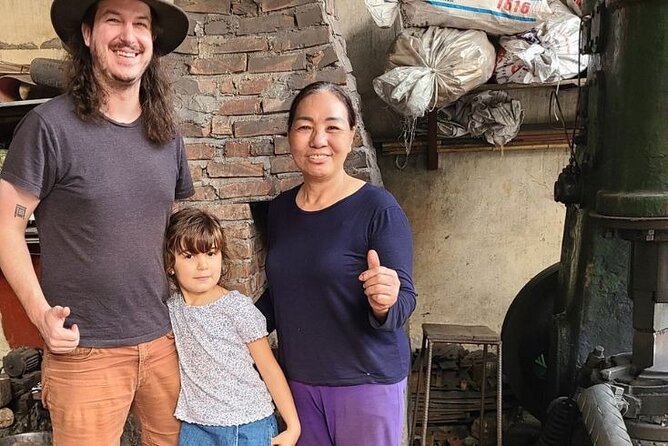
At the workshop, you are introduced to the local makers and shown how the work is done. The family-run setting is one of the experience’s best features. It gives the class a personal feel, with direct contact rather than a large commercial demonstration.
The English-speaking guide acts as your bridge. The artisans may not speak English, so the guide translates instructions and explains what is happening at each stage. Tee received especially strong praise for making the process clear and helping with translation. Nathan, Khoi, Minh, and other guides were also noted for being friendly, punctual, and involved throughout the visit.
The hospitality goes beyond the knife itself. Depending on the session, you may be offered water, tea, fruit, candy, or a simple snack. One guide even stopped at a favorite food place when a participant was hungry. These touches are not the main reason to book, but they help the workshop feel like an invitation into a family business.
Group size can be small, and some sessions have been private or nearly private. That matters when you are holding hot metal or trying to follow instructions through translation. With fewer people, the master can spend more time adjusting your grip and helping you correct the blade.
Choosing a blade before the fire
The session begins with a design choice. You may select from several knife styles or use a photo as a guide. The available choices have included kitchen knives and other practical shapes. Some people choose a design offered by the artisan, while others create a hybrid based on a familiar Japanese style.
You then sketch the blade shape onto a piece of metal chosen for durability. This first stage looks simple, but it gives you a better sense of how much planning goes into a finished knife. The outline must account for the blade and the tang, the section that extends into the handle.
This is also where you should be realistic. You are not ordering a completely custom knife with unlimited options. The final result depends on the metal, the time available, and what the artisan can safely guide you through. Still, having a choice of design makes the souvenir feel personal.
If you want a particular shape, bring a clear photograph on your phone. A photo can help the guide and artisan understand what you have in mind, especially when language makes detailed discussion difficult.
Hammering steel beside the master
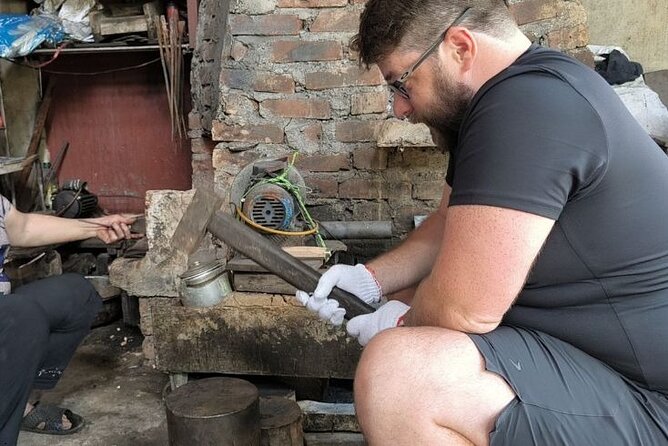
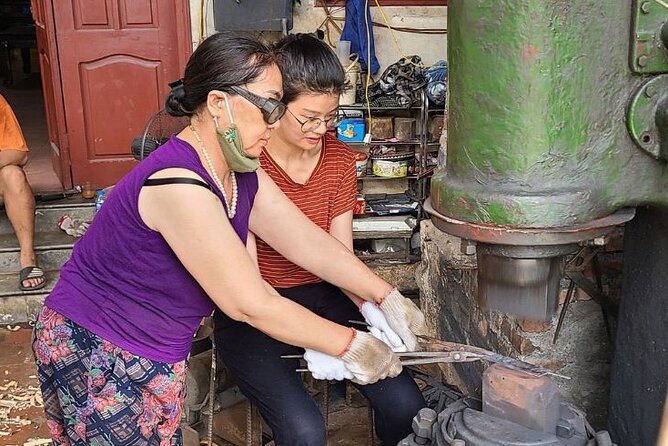
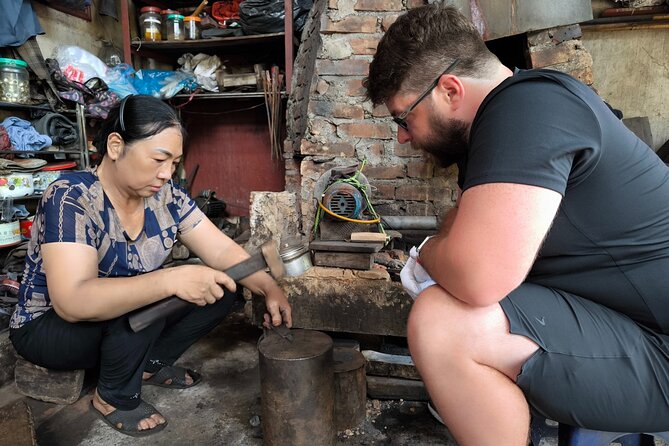
The forge is the heart of the class. The metal is heated in glowing embers, then cut and shaped with a hammer, cutter, and anvil. You work alongside the maker, taking turns with the hammer as the blade begins to form.
This is the part most people anticipate, and it delivers the strongest physical sense of blacksmithing. You feel the weight of the hammer, hear the metal being struck, and see the shape change under repeated blows. It also quickly shows why trained makers make the work look easier than it is.
The artisans guide your hands and correct your technique. That support is useful for first-timers, but it also creates the main difference between this class and a serious blacksmith course. Some people get substantial hands-on time. Others may spend only a few moments hammering while the master completes the more exact work.
The best approach is to tell the guide how involved you want to be. One useful arrangement described during a session was a choice between doing as much as possible yourself or letting the professional handle most of the work. If you want to take part in every safe stage, say so early.
A hydraulic cutting machine is used to trim imperfections. Because this equipment is dangerous, you should expect the artisan to operate it. The same applies to any step where a mistake could cause a serious injury. You get the rewarding parts of the craft without pretending that a three-hour class can replace decades of practice.
Same city, a very different kind of morning:
- Hanoi Jeep Tour: Food, Culture and Fun by Vietnam Army Jeep
★ 5.0 · 15,222 reviews - Full-Day Ninh Binh Highlights Tour from Hanoi
★ 5.0 · 7,761 reviews - Hanoi: Ha Long Bay Day Cruise – Swimming, Meal, Kayaking
★ 4.7 · 7,415 reviews - Hanoi: Water Puppet Show Tickets
★ 4.6 · 7,029 reviews
Shaping, tempering, and sharpening
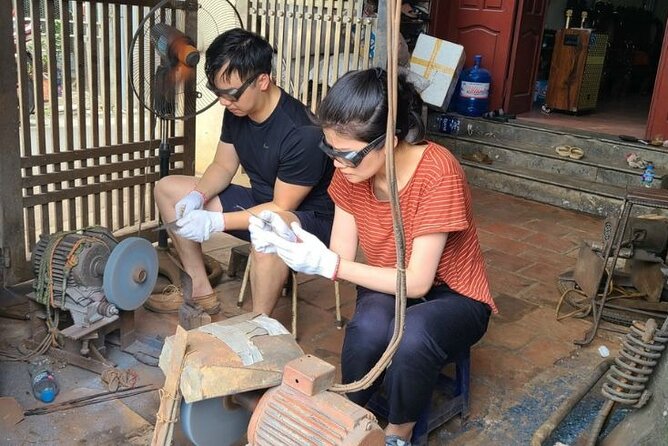
Once the rough blade has been forged, it is refined. The artisan trims uneven edges and works the metal into a cleaner profile. You may be able to help with several of these steps, depending on the knife and the group.
The blade is then sharpened on a grindstone. Sharpening is not one quick pass. It takes several stages and requires control, patience, and a steady angle. This is a good point in the process to appreciate the artisan’s skill. A blade that looks finished can still need careful work before it cuts properly.
The tempering stage adds another distinctive detail. The knife is soaked in a tar-based chemical wash made from a secret family recipe. You should not expect a technical explanation of the formula, but this step shows that the workshop’s methods are not limited to hammering and grinding.
Some participants were able to help temper the metal and craft the handle. Others had more limited involvement in the finishing work. Your level of participation can depend on safety, time, the group size, and the design you choose.
At the end, the knife is brought to a sharp finish. Several people were surprised by how professional the completed knives looked. That does not mean every blade will be identical, or that your first attempt will be perfect. It means the master’s finishing work turns your rough contribution into something you can actually use.
Making a handle that fits your hand
The handle gives the knife another personal touch. You may help carve or shape the wooden handle, then work toward a grip that feels comfortable in your hand.
This stage is easy to overlook, but it is one of the best ways to make the souvenir yours. A blade can be attractive, yet the handle determines how the knife feels during ordinary use. The artisan helps you keep the proportions practical and the fit secure.
If you are making a knife as a gift, think about the recipient before you arrive. A handle shaped for your own hand may not suit someone else. The class information confirms that the product is included, and several participants left with one or more usable kitchen knives.
Some people also bought additional knives at reasonable prices. Any extra purchase is separate from the $50 activity fee, but the opportunity may appeal if you like the workshop’s style.
How hands-on is the class?
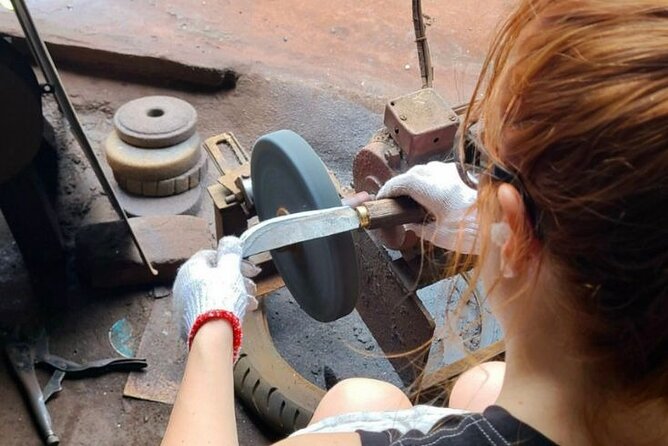
This is the most important question to ask before booking. The class covers the complete knife-making process, but complete does not mean you independently perform every operation.
The artisans supervise the work closely. You may sketch the blade, hammer heated metal, help shape it, grind and sharpen parts of it, and work on the handle. The master steps in when precision or safety requires it.
That arrangement suits true beginners. You can try the tools without being left alone with hot steel or powerful machinery. It also means the finished knife is likely to be far better than anything a first-time maker could produce without help.
If you already have serious do-it-yourself or metalworking experience, you may find the class less technical than hoped. One participant felt that only a small amount of hammering was allowed, while another reported doing nearly every safe step. These different impressions probably reflect the group, guide, and level of confidence on the day.
For the best result, make your preference clear: I want to do as much as is safe. Listen when the master stops you. A lost finger is a poor souvenir.
What the $50 price includes
At $50 per person, the class offers solid value because the fee includes more than instruction. You receive:
- Hotel pickup and return transport
- English-speaking guidance and translation
- The master artisan’s instruction
- Workshop equipment
- Your finished knife
- One 500-milliliter bottle of water
Transport alone adds real value, since Da Sy is outside central Hanoi. You also avoid having to arrange a taxi to a village workshop where communication could be difficult.
The knife is the other major part of the value. You leave with a practical object tied to the place you visited, not just a certificate or a photograph. The final quality depends on how much the artisan completes, but the finished product has a stronger connection to the experience than a standard shop purchase.
Small groups improve the value further. You get more direct help and less waiting around. The class has a five-out-of-five rating based on 87 reviews, with repeated praise for the guides, family hospitality, and the chance to leave with a sharp, attractive knife. The rating is strong, but I would still focus on the hands-on limits before booking.
A $10 surcharge applies during New Year and Tet, Liberation Day or Reunification Day on April 30, International Workers’ Day on May 1, and National Day on September 2.
Practical advice for a safe, comfortable visit
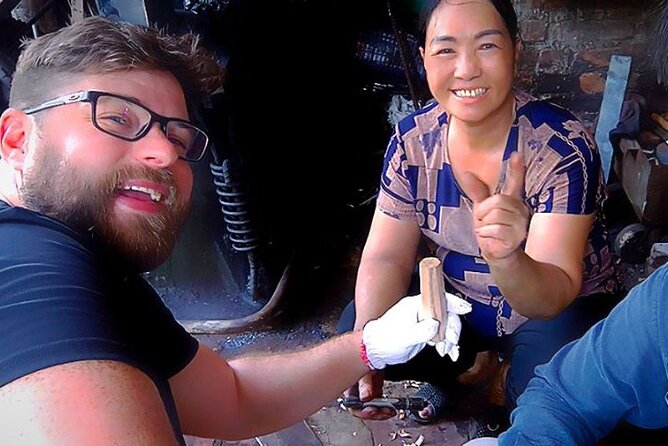
Wear comfortable shoes. The workshop involves standing, moving around equipment, and working near a forge, so footwear matters more than dressing up for Hanoi sightseeing.
Pay attention to every safety instruction. Use the gloves provided or recommended by the workshop, and keep your hands clear of cutting and grinding equipment. The forge is exciting, but hot metal and sharp blades deserve full attention.
Do not bring alcohol or drugs. This is a hands-on activity around fire, machinery, and very sharp tools.
The listed duration is three hours, though individual sessions may feel shorter or longer depending on transport, group size, and how much hands-on work you do. Check the starting time when you book, then leave room in your day rather than scheduling a tight connection afterward.
Free cancellation is available up to 24 hours before the activity for a full refund. You can also reserve now and pay later, which helps if your Hanoi plans are still changing.
Who will enjoy this most?
I would recommend this class to curious first-timers, home cooks, craft fans, and anyone who wants a souvenir with a story. It also suits families with older children and teenagers, since one group of six, including teens, enjoyed choosing designs and taking part in the process.
It is a good choice for a cooler or rainy Hanoi morning when you want an activity beyond temples and cafés. The workshop gives you something physical to do and introduces you to a local trade at the same time.
Couples and solo visitors can benefit from the small-group format. Private sessions have offered especially personal instruction, with the guide translating continuously and taking photos and videos along the way.
I would be more cautious if you want advanced metalworking tuition. The class is built for beginners, and the master will finish important sections to protect you and improve the knife. It is also not suitable for people over 95, according to the activity information.
FAQ
How long does the Hanoi knife-making workshop last?
The listed duration is three hours. Starting times vary, so check availability when booking. Some individual experiences have taken around two hours, but you should allow three hours in your schedule.
What does the $50 price include?
The price includes English-speaking instruction, the master artisan, workshop equipment, your finished knife, one 500-milliliter bottle of water, and hotel pickup and return transport.
Do I need previous blacksmithing experience?
No. The class is designed for beginners, and the artisans guide you through the process. You may take part in many safe steps, while the master handles dangerous or highly technical equipment.
Can I choose the knife design?
Yes. You can choose from available designs, and the information also allows you to use a photograph as inspiration. The final choice should be discussed with the guide and artisan before work begins.
Is hotel pickup included?
Yes. Pickup is included, and you should wait five minutes in your hotel lobby. The workshop is in Da Sy village, outside central Hanoi.
Can I cancel the booking?
Yes. You can cancel up to 24 hours in advance for a full refund. Reserve now and pay later is also available.
Should you book the Da Sy knife class?
Book it if you want a hands-on cultural activity and a useful souvenir, especially if you like crafts, cooking, tools, or local family businesses. The included transport, English support, finished knife, and small-group option make $50 a fair price.
Go in with the right expectations. You will help make a knife, but you will not work alone like a trained blacksmith. Tell the guide that you want maximum safe participation, wear proper shoes, respect the machinery, and let the artisans handle the dangerous parts.
For most visitors, that balance is exactly right. You get close to a centuries-old village trade, meet the people keeping it alive, and return to Hanoi with something made through your own effort. That is a much better souvenir than another mass-produced magnet.
New around Hanoi
- Private LUXURY Hanoi City Full day guided tour★ 4.5 · 21 reviews
- Private transfer between Hanoi and Sapa★ 5.0 · 27 reviews
- Private Transfer Hanoi <=> Mai Chau One Way (Free hotel pickup)★ 5.0 · 22 reviews
- Private Transfer from Ninh Binh to Halong or Halong to Ninh Binh★ 5.0 · 21 reviews
- Private Transfers Hanoi <=> Halong One Way (Free Hotel Pickup)★ 5.0 · 31 reviews
- Hanoi Airport See-off (Private Ride from Hotels to Hanoi Airport)★ 4.5 · 70 reviews
- Thang Long Water Puppet Theater★ 4.5 · 45 reviews
- Private transfer Ninh Binh <=> Halong One Way (Free Hotel Pickup)★ 5.0 · 21 reviews
Hanoi Tours, compared.

Hanoi Jeep Tour: Food, Culture and Fun by Vietnam Army Jeep
Read our review →
Full-Day Ninh Binh Highlights Tour from Hanoi
Read our review →
Ha Long Bay Day Cruise – Swimming, Meal, Kayaking
Read our review →

Hanoi Motorbike Tour: Food, Culture and Fun by Vintage Motorbike
Read our review →

Hanoi Cooking Class: Culture, Local Market & Meaning CSR Impact
Read our review →
5 Traditional Dishes Hanoi Cooking Class with Market Trip
Read our review →Browse the lists this tour appears in